Garett Jones
BB&T Professor for the Study of Capitalism
and
Associate Professor
Center for Study of Public Choice
Curriculum Vitae
Google
Scholar
email: jonesgarett@gmail.com twitter: GarettJones
______________________________________________________________________________________________
Books
10% Less Democracy: Why You Should Trust Elites a
Little More and the Masses a Little Less, published in
2020 by Stanford University Press. Free
introduction here.
First sentence: “Once I got the call from
campus police, I knew I needed to write this book.”
[Amazon] [Stanford UP]
Endorsements for 10% Less Democracy:
“10% Less Democracy is a joy to read. If you liked Freakonomics or Predictably Irrational, you’ll love this book. It deserves to be read widely, widely
discussed—and acted upon. A tour de force combining the best economic insight with real-world, practical
applications. Every chapter demonstrates ways in which reducing democratic
control over certain decisions reliably results in better outcomes for all.”
Jason Brennan, political
philosopher at Georgetown University and author of Cracks
in the Ivory Tower.
“How can we rescue
democracy from the slough of despond into which it has fallen? In this lucidly
written book, Garett Jones makes the case for a surprising answer: the best way
to improve democracy is to have a bit less of it. It’s only by handing power to
technical experts, lengthening congressional terms, staggering elections, and
reducing direct democracy that we can save the invaluable core of democracy
from self-destruction.”
Adrian Wooldridge,
Bagehot columnist for The Economist and co-author (with Alan Greenspan) of Capitalism
in America: An Economic History
“Invocation of
‘democracy’ is one of the most ill-defined canards of modern discourse. In this
revisionist work, rooted in common sense, Jones shows that effective
representative government does not in fact rest on pure democracy, but does
rely on well-functioning elites. Definitely recommended.”
Tyler Cowen, Holbert L.
Harris Chair of Economics at George Mason University and author of Big Business: A Love-Letter to an American Anti-Hero
“The belief in
democracy is strong in most rich, democratic countries, even sacred. Why in the
world would anyone propose ten percent less of it? The key is sharpening our
thinking on what ‘democracy’ means. Once we allow a sharper definition,
decision-making by the vote of all, we demystify ‘democracy’ and more sensibly
assess its pluses and minuses. Jones’ argument is persuasive and rests on
global data.”
Charlotta Stern, Professor of
Sociology, Stockholm University, and Deputy Director of the Ratio Institute
“If a genie told
me that James Madison had been reincarnated as another person and had written
an update to the Federalist Papers, I’d say, ‘It’s Garett Jones and 10%
Less Democracy, right?’”
Tim Groseclose, Professor of Economics, George Mason University
Hive
Mind: How your nation’s IQ
matters so much more than your own, published by Stanford University Press.
Now in paperback, and $11.99 on Kindle!
[Amazon] [Stanford UP]
“I must say, the finest fusion of economics and psychology is not some book on nudges or biases, but The Hive Mind by Garett Jones. It’s also the first time that differential psychology has been substantively applied by an economist to the questions of economic development and political economy.” –Pseudoerasmus.
“Anyone interested in education, social science, or economics should read this book...a model of non-fiction writing.' –Adam Ozimek at Forbes
“…[T]he book is excellent, and well worth reading…This is a model of concise explanatory writing.” –Economist Dietrich Vollrath
“On balance this is a notable text—perhaps
2016’s most important economics book, both for the development specialist and
the general reader.” –Economist Fred Thompson in Governance
“…[I]f you only have time to read one economics book this year, make it Garett Jones’s Hive Mind…” –Economist Scott Sumner
“Summing up: Recommended. All Readers.” [Also ‘Community College Recommended’] –E.L. Whelan, Choice: Current Reviews for Academic Libraries.
The introduction, free here, offers an overview of Hive Mind’s thesis, as well as evidence for the Paradox of IQ. Chapter 1, also free, reviews the mainstream evidence that IQ tests are more than just a test score: Modern IQ tests predict brain size, reaction time, job performance, and emotional intelligence.
Stanford UP created a 3-page infographic that shows how your nation’s IQ matters more than your own: It sums up the core argument of Hive Mind. The PDF slides from one of my recent talks on Hive Mind are here.
Two podcast interviews about Hive Mind. Both discuss joint causation between IQ and income, the potential of genetic engineering, and more:
With Jim Pethokoukis of the American Enterprise Institute
With Simon Fraser University’s Garrett Petersen
And here, The Wall Street Journal tells the story of how I chose my book title.
Banking Crises: Perspectives from the New Palgrave Dictionary, editor, published by Palgrave Macmillan.
This collection of articles from the New Palgrave, the oldest encyclopedia of economics, offers a variety of serious perspectives of financial crises and their cure. From contributors like the post-Keynesian scholar Randall Wray to New Keynesian theorist Gauti Eggertson to the financial historian Charles Calomiris, the collection offers both historical, theoretical, and experimental takes on the recurring problem of fragile finance.
____________________________________________________________________________________________
Biography
After earning a BA in history from Brigham Young
(with a sociology minor), an MPA from Cornell, and an MA in political science
from UC Berkeley, I earned my Ph.D. at UC San Diego in 2000. My dissertation
was on how the Federal Reserve can control short-run interest rates, and used
accidental increases and decreases in bank reserves to estimate the economic
effects of what we would now call quantitative easing.
I enjoy backpacking in the High Sierra, getting lost in Venice, and looking for the best food in Chengdu. In the past, I’ve worked in the U.S. Senate, and my research areas include behavioral economics, monetary economics, corporate finance, and economic growth. Media appearances include C-Span’s Washington Journal, the Washington Post, the Wall Street Journal, Bloomberg BusinessWeek, Fox Business, and the New York Times; a more complete collection here.
______________________________________________________________________________________________
Selected Academic Papers
IQ and National Productivity
(New Palgrave Dictionary of Economics, 2011)
Abstract: A recent line of research in economics and
psychology hypothesizes that differences in national average intelligence,
proxied by IQ tests, are important drivers of national economic outcomes.
Cross-country regressions, while showing a robust IQ-growth relationship,
cannot fully test this hypothesis. Thus, recent work explores the
micro-foundations of the IQ-productivity relationship. The well-identified
psychological relationship between IQ and patience implies higher savings rates
and higher folk theorem-driven institutional quality in high average IQ
countries. Experiments indicate that intelligence predicts greater pro-social
behavior in public goods and prisoner’s dilemma games, supporting the
hypothesis that high national average IQ causes higher institutional quality.
High average IQ countries also have higher savings intensity by a variety of
measures. Other possible IQ-productivity channels are discussed, as are possible
environmental causes of differences in national average IQ.
Average Player Traits as Predictors of Cooperation in a Repeated Prisoner’s
Dilemma
(With Omar al-Ubaydli
and Jaap Weel, Journal
of Behavioral and Experimental Economics, 2016)
Abstract: Many studies
have looked at how individual player traits influence individual choice in the
repeated prisoner's dilemma, but few studies have looked at how the average
traits of pairs of players influence the average choices of pairs. We consider
cognitive ability, patience, risk tolerance, and the Big Five personality
measures as predictors of individual and average group choices in a 10-round
repeated prisoner's dilemma. We find that a pair's average cognitive ability
measured by Raven's cognitive ability test predicts average cooperation rates
robustly and average earnings more modestly. Openness predicts both greater
joint cooperation and the use of reciprocity to sustain cooperation.
Human Capital and Institutional Quality:
Are TIMSS, PISA, and National Average IQ robust predictors?
(With Niklas Potrafke, Intelligence, 2014)
Abstract: Is human capital a robust predictor of good institutions? Using a new institutional quality measure, the International Property Rights Index (IPRI), we find that cognitive skill measures are significant, robust, and large in magnitude. We use two databases of cognitive skills: estimates of national average IQ from Lynn and Vanhanen (2012a) and estimates of cognitive ability based on Programme for International Student Assessment (PISA) and Trends in International Mathematics and Science Study (TIMSS) scores estimated by Rindermann et al. (2009). The Rindermann cognitive ability scores estimate mean performance as well as performance at the 5th and 95th percentiles of the national population. National average IQ and the 95th percentile of cognitive ability are both robust predictors of overall institutional quality controlling for legal system, GDP per capita, geography dummies, and years of total schooling. Some possible microfoundations of this relationship are discussed.
Patience, Cognitive Skill, and
Coordination in the Repeated Stag Hunt
(with Omar al-Ubaydli and Jaap Weel, Journal of Neuroscience, Psychology, and Economics, 2013)
The O-Ring Sector and the Foolproof
Sector: An Explanation for Skill Externalities
(Journal of Economic Behavior and Organization, 2013)
Abstract: If intelligence or other skills are as important as some people say, why do markets reward these skills so modestly? Informally, if you’re so smart, why aren’t you rich? I offer a general equilibrium model to explain this puzzle: The core assumption is that in some (but not all) sectors of the economy, lower-skilled workers can be good substitutes for higher-skilled workers. This is true even though in the cutting-edge sectors of the economy, lower-skilled workers are poor substitutes for higher-skilled workers. In equilibrium the economy-wide wage gap is pinned down by the sectors where high and low skilled workers are the best substitutes for each other, not the worst.
IQ and Entrepreneurship: International
Evidence
(with R.W. Hafer, April
2012)
Abstract: National measures of cognitive skill, including IQ tests, have received attention recently as a possible driver of cross-country productivity differences. In a parallel literature, national measures of entrepreneurial activity and pro-entrepreneurship policies have received similar attention. This paper is the first to demonstrate that higher national average IQ reliably predicts higher ratings for the Acs-Szerb Global Entrepreneurship Development Index (GEDI). Results hold after controlling for GDP, education levels, inequality, broad economic freedom indices, and other factors. Microfounded explanations for these results are considered.
Will the Intelligent Inherit the Earth? IQ
and Time Preference in the Global Economy
(February 2012)
Abstract: Social science research has shown that intelligence is positively correlated with patience and frugality, while growth theory predicts that more patient countries will save more. This implies that if nations differ in national average IQ, countries with higher average cognitive skills will tend to hold a greater share of the world’s tradable assets. I provide empirical evidence that in today’s world, countries whose residents currently have the highest average IQs have higher savings rates, higher ratios of net foreign assets to GDP, and higher ratios of U.S. Treasuries to GDP. These nations tend to be in East Asia and its offshoots. The relationship between national average IQ and net foreign assets has strengthened since the end of Bretton Woods.
U.S. Troops and Foreign Economic Growth
(with Tim Kane, Defence and Peace Economics, 2012)
PDF Excel with Readme Original Kane Dataset on Troop Deployments, 1950-2003
The Bond Market Wins
(Econ Journal Watch, 2012)
Human Capital in the Creation of Social
Capital: Evidence from Diplomatic Parking Tickets
(with John Nye, 2011)
Link Media Coverage in WSJ, Real Time Economics
National IQ and National Productivity: The
Hive Mind across Asia
(Asian Development Review, 2011)
Speed Bankruptcy: A Firewall to Future
Crises
(Published in Journal of Applied Corporate
Finance, Summer 2010)
Cognitive Ability and Technology
Diffusion: An empirical test
(Economic Systems, 2012)
IQ in the Production Function: Evidence
from immigrant earnings
(Economic Inquiry, 2010)
Are Smarter Groups More Cooperative?
Evidence from repeated prisoners’ dilemma experiments, 1959-2003
(Published in Journal of Economic Behavior and
Organization, 2008)
PDF Results for Corrected and Extended Datasets, 2013
Dynamic IS Curves With and Without Money:
An international comparison
(with R.W. Hafer,
Published in Journal of International Money and Finance, 2008)
On Money and Output: Is money redundant?
(with R.W. Hafer and
Joseph Haslag, Published in Journal of Monetary
Economics, 2007)
Intelligence, Education, and Economic Growth:
A Bayesian averaging of classical estimates (BACE) approach
(Published in Journal of Economic Growth,
March 2006)
______________________________________________________________________________________________
Additional Writings and
Presentations
The Populist
Revolts of 2016: A Hidden Cost of Immigration?
“The
populist backlash against immigration is strong evidence that a mass influx of
lower-skilled workers can lower the quality of political institutions. This
prospect should therefore encourage social scientists to study the ways that
national demographic changes shape the governments that rule over us.”
A simple
illustration of Buchanan-style Club Goods, some calculus
Will Open
Borders change your nation’s SAT score?
Powerpoint, based on this
debate with Bryan Caplan at Northwood University, 2015.
10% Less
Democracy: How Less Voting Could Mean Better Governance
Precautionary
Saving: A two-period illustration
There
are few good closed-form results for precautionary saving, here’s a simple
example that you might find useful if you’re learning or teaching dynamic
economics with a little math.
One page PDF Excel with graphs,
closer to the intermediate macro level
Using the Solow Growth Model as a
Forecasting Tool
Does today’s fast growth in country X signal that country X is catching up to the economic frontier? Or will the growth likely sputter out far before country X catches up?
Abstract: If a moderately rich country grows fast, that’s a strong signal of convergence, according to the Solow Model. But a poor country has to be growing exceptionally fast for it to be a signal that they’re one their way to catching up with the global frontier.
The Redistribution Impossibility
Theorem: An open economy exposition
A 2-page discussion of the Redistribution
Impossibility Theorem
Abstract: As a rule, in a global economy with mobile capital, taxing capitalists to give the money to workers makes workers worse off.
Did Stimulus Dollars Hire the Unemployed? and No Such Thing as Shovel Ready
(Mercatus Center Working Papers, with Daniel Rothschild, 2011)
A Political Coase Theorem for the
Intelligent
(Slide presentation at Konstanz University, 2011,
and Public Choice World Congress, 2012)
The Economics of Financial Crises
(Slide presentation for Moscow State University
graduate students visiting GMU, December 2009)
The Great Recession
(Slide presentation for George Mason University’s
inaugural Alumni Weekend, October 2009)
Economics of the Geithner Plans
(Slide presentation for the Mercatus
Center’s Capitol Hill Campus series, April 2009)
Tax 101
(Slide presentation for the Mercatus
Center’s Capitol Hill Campus series, March 2009)
Imitate FDR’s Treasury Secretary:
Bankruptcy not Bailouts
(November 2008: Published in U.S. Exchequer,
pages 45-46)
_______________________________________________________________________________________________
Miscellany
My media clippings, catalogued by Mercatus.
My Twitter feed, GarettJones: All the economics I can fit into 280 characters.
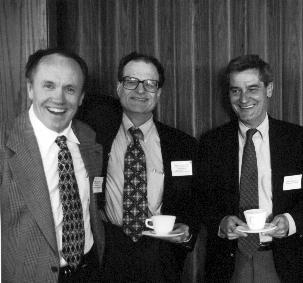
A macroeconomic revolution all in one photograph.
An outdated photo of me in my office in Carow Hall.
A 2009 photo of my brother Jerry and I backpacking in the Vogelsang section of Yosemite National Park. Photo taken by my brother Mitch.
A TV series you really ought to watch, Milton Friedman’s Free To Choose.
And another: The first sitcom inspired by public choice theory, Yes Minister.
Another kind of spontaneous order.