


I finally completed my dissertation proposal! I’m a bit late in posting about it, but I had some other stuff going on.
My proposal (lengthily titled Random complexes, sampling, and simulation in three or more dimensions) introduces two new random surfaces based on a topological generalization of the graphical spanning tree called the \(d\)-dimensional spanning tree (or \(d\)-tree, for short). The generalization (developed by Art Duval, Caroline Klivans, and Jeremy Martin) takes the two graphical properties that characterize a spanning tree and re-frames them homologically:
and
In a follow-up, Olivier Bernardi and Caroline Klivans introduce the (directed) rooted \(d\)-forest, which comprises a pair of simplicial complexes \((F,R)\) where \(R \subset F\) and \(H_d(F,R;\mathbb Q) = 0 = H_{d-1}(F,R;\mathbb Q)\). The rooted \(d\)-forest is the dimension-agnostic analogue of the relative spanning tree \((F,R)\), where \(F\) is a spanning forest and \(R\) is a collection of vertices in \(F\) such that collapsing all the vertices in \(R\) to a single vertex doesn’t introduce a cycle (making the quotient graph \(F/R\) a tree).
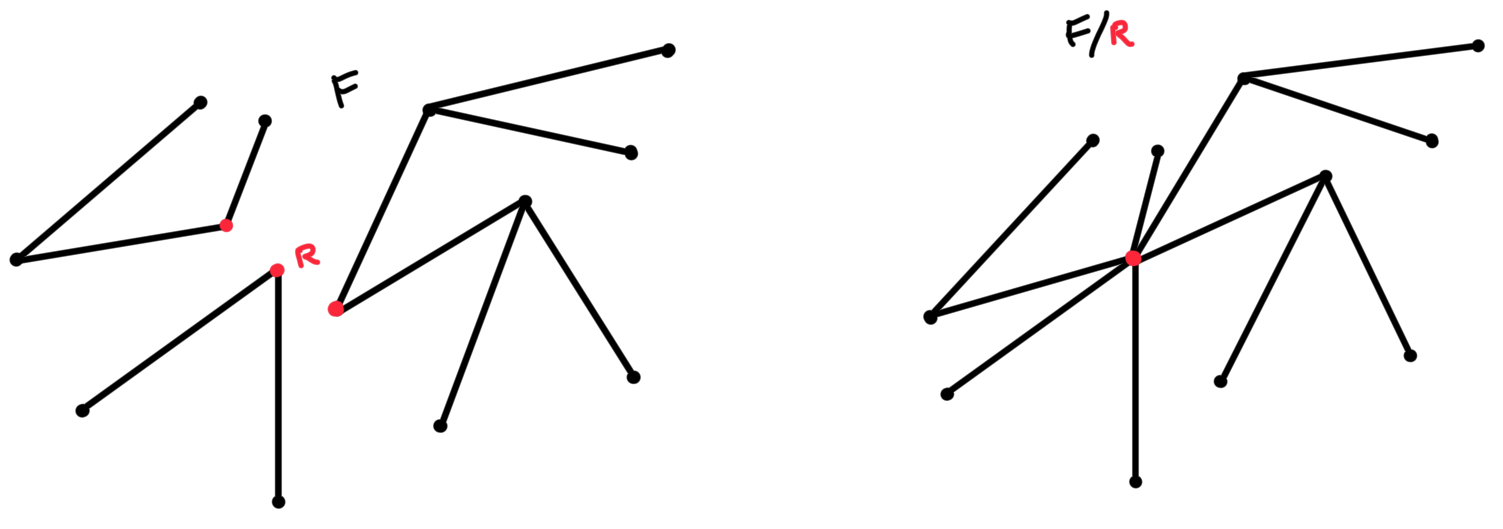
(Left) a forest \(F\) with the root \(R\) in red. \(F\) is a forest, so it already has to be acyclic and spanning, it just doesn’t have to be connected. (Right) quotienting \(F\) by \(R\) gives us a connected acyclic graph (aka a tree).
In the figure, notice that \(R\) contains exactly one vertex per component of \(T\) — if \(R\) contained (say) two vertices in a component, those vertices would become the same vertex in the quotient, creating a cycle. This idea generalizes nicely: the complex \(R\) can’t contain an \(F\)-boundary, since “closing up” the boundary would create a cycle. If we instead try a \(2\)-complex \(F\) that contains the whole \(0\)-skeleton (i.e. all the vertices), the whole \(1\)-skeleton (i.e. all the edges), and the faces \(\{a,b,c\}\), with a root \(R\) containing all the red edges, we get a quotient complex like this:
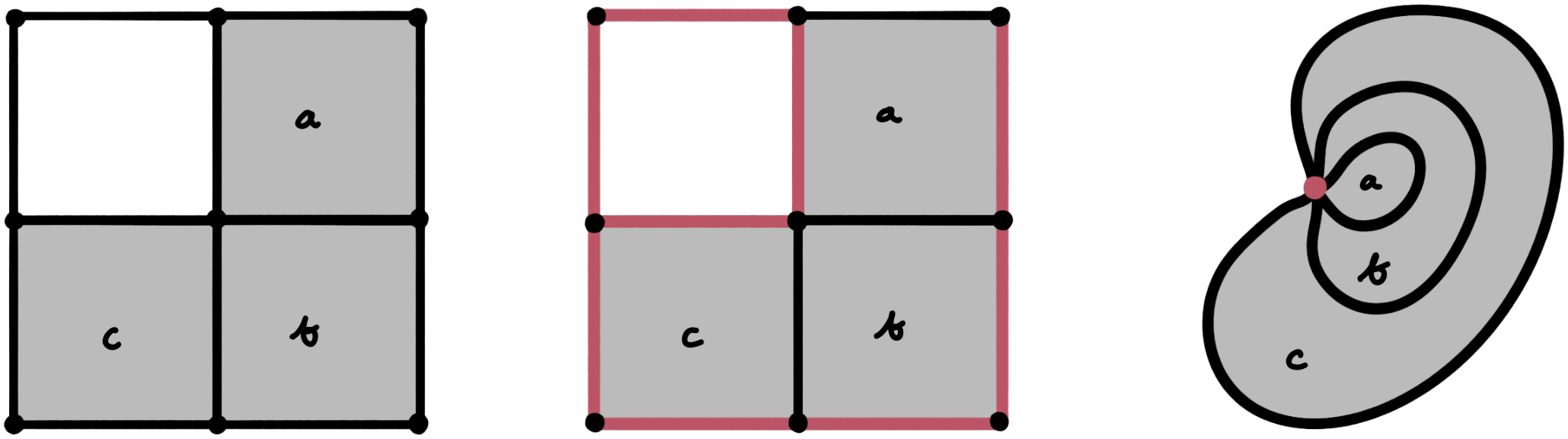
(Left) the complex \(F\). (Middle) \(F\) overlaid with \(R\). (Right) the quotient complex \((F,R)\), which looks somewhat like an ear.
There are (primarily) two interesting things about this picture:
- The number of edges included in \(R\) is the same as the number of faces included in \(F\). (Sounds familiar…)
- The \(\mathbb Q\)-homology of \(F/R\) is trivial in every dimension.
Much like graphical trees, the reason to look at the (relative) spanning acycles of a complex is to filter out “noisy” topological information that garbles the underlying structure of the complex. For example, if we were to include the boundary of a \(2\)-cell in \(R\), the second condition would fail:
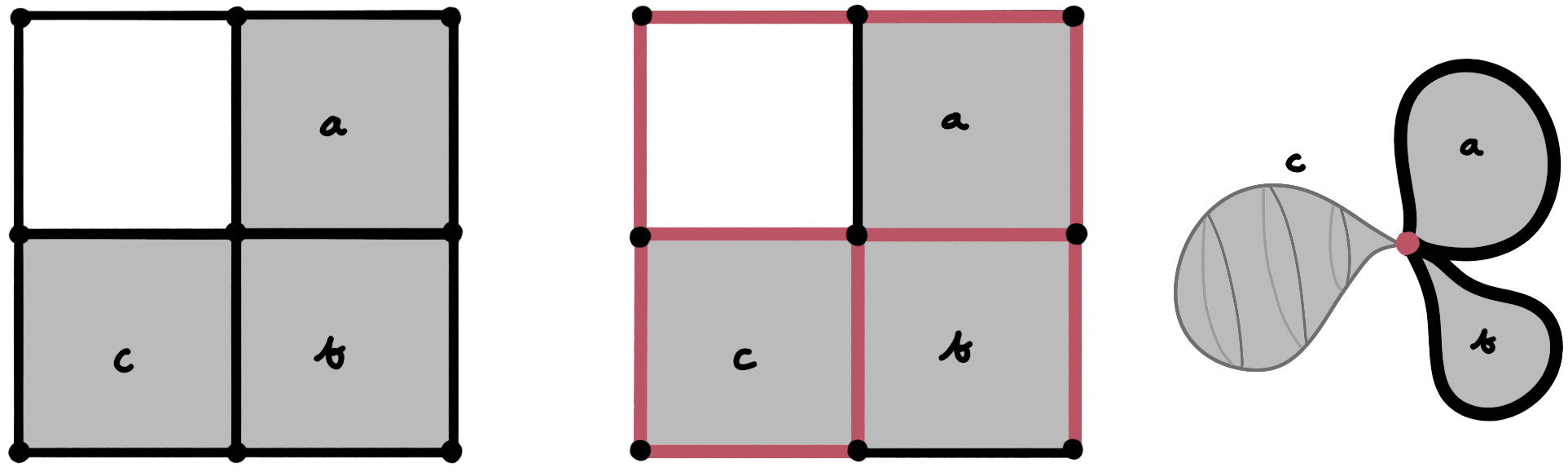
(Left) the complex \(F\). (Middle) \(F\) overlaid with \(R\). (Right) the quotient complex \((F,R)\), which looks like the wedge of two disks and a sphere. Importantly, \(c/R\) — the quotient of \(c\) by \(R\) — becomes the boundary of a \(3\)-cell, which is a \(2\)-cycle in this space.
Things get interesting when we take our homology coefficients over, say, \(\mathbb Z\) instead of the rationals: suddenly, we’re no longer guaranteed to have trivial first homology — even though the rank of \(H_{d-1}(F,R;\mathbb Z)\) is zero — because we can encounter torsion. If our space has torsion, then (intuitively) “clockwise” can mean different things depending on our location in the space; the Möbius band is a cardinal example. If \(F/R\) has torsion, then the torsion subgroup attached to \(H_{d-1}(F,R;\mathbb Z)\) will be finite (e.g. \(\mathbb Z/2\mathbb Z)\) — so \(F/R\) is a \(d\)-RST for each choice of orientation. Were we to put a measure on the \(d\)-RSTs, the ones with torsion would account for more weight than torsionfree ones.
I won’t spoil the rest. Proposal’s below.