Beginning Web Design
Make a Plan
Navigation:
Home
Make a Website
Creating an effective and usable website isn't something you do on a whim - it takes a LOT of planning.
This page will take you right through the planning process and fully prepare you to make your idea a reality.
1. Understanding User Experience
The very first thing you should consider is the importance of user experience - after all, a positive user
experience is what web design is all about. Author Jessie James Garrett describes a scenario where a man
misuses his coffee maker because the machine does not beep to confirm that he has pushed the power button.
This is an example of bad user experience: if the design of the coffee maker had been better, the man would
not have encountered this problem. When making a website, it is important to remember not only what that website
does, but how it does it. The how results in either a positive or negative user experience.
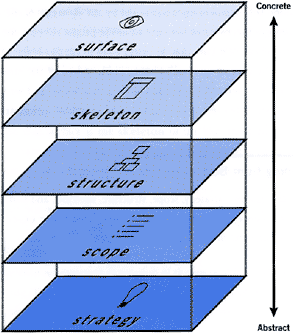
2. Garrett's Elements: The Five Planes
Lets go back to Garrett for a little. In his wonderful book, The Elements of User Experience, Garrett offers
a helpful, 5-element model for thinking about web design:
The Surface Plane: The surface plane is what you see right in front of you: web pages that include images, text, and links.
The Skeleton Plane: The skeleton plane is the arrangement of all of these visual elements, such as buttons or blocks of text.
The skeleton insures that you will understand and remember things based on how they are arranged.
The Structure Plane: The structure plane is more abstract, and refers to how users get to the
web page, where they can go next, and what sorts of categories the web page contains.
The Scope Plane: The scope plane constitutes what the site contains, or
what it covers. The features, functions, and information on the site all falls under the scope.
The Strategy Plane: Finally, the strategy plane looks at the purposes for the site. What do both the web designer and
the web users want out of this particular site? The strategy plane must answer this question.
These 5 planes are a wonderful guide to creating a site with users in mind. As you go forward, regularly refer back to Garrett's elements and
use them as your model.
3. Perfecting Your Strategy
So now that we've talked about strategy, what's yours? One of the first things you must figure out is the over-all purpose of your site.
Ask yourself some of the following questions: What is this site all about? What do you want it to do for you? What do you want it to
do for your users? What should it include and leave out? This part is all you - if you don't have a vision, you can't build a website.
4. Planning Your Content
Although you don't need your content quite yet, you should start thinking about what it's going to be. If you're building a portfolio of your
writing work, you'll need the work itself, as well as some introductory content, perhaps. If you're creating a blog, your content might include
posts that pertain to different categories, as well as your contact information. Try to be as specific as you can when planning the content
of your site. Something else to consider is the scope of this content - for example, how many written works should you include in your portfolio?
You want to give future employers a good idea of your talent without overwhelming with everything you've written since third grade.
5. Connecting Strategy and Content
Now it's time to think about your strategy in relation to your content, and vice versa. How will your content achieve the over-all site goal?
What tools do you need and/or have? Is the site interactive or not? What kinds of functions must it be capable of? Once you've answered those
questions, you are ready to begin putting your plan into action!


by Mikal Cardine
Last Updated: 3/22/2015 Completion Date: 3/25/2015

This work is licensed under a Creative Commons Attribution-NonCommercial-NoDerivatives 4.0 International License.