2026 Venezuela Earthquake Recovery

An initiative led by C-RASC at George Mason University in partnership with the GulfStream Foundation, transforming earthquake-related data from citizen sensing, geospatial observations, and damage assessments into actionable intelligence for relief and recovery efforts while advancing evidence-based disaster research.

Research Background

The project collects, integrates, and analyzes heterogeneous data sources to transform raw data into structured knowledge. By leveraging human-AI collaboration methods, it reduces information overload for emergency responders and relief workers, making unstructured crisis data actionable for decision support in emergency services and humanitarian organizations.

Visit the Informatics Lab for Ongoing projects

Featured Tools

Two systems were rapidly developed in the aftermath of the June 2026 Venezuela earthquake context — one focused on social media signals for help-seeking and resource needs, and the other on geospatial visualization of damage and infrastructure knowledge.

Citizen Sensing

CHORD: Citizen-Helper Operational Recovery Dashboard

Leveraging the Citizen-Helper platform, the tool collect and integrates disaster-related content from YouTube and Reddit in the context of the 2026 Venezuela earthquakes and transforms it into actionable intelligence using AI methods. Interactive visualizations enable response teams to rapidly assess needs, identify emerging issues, and prioritize relief efforts.

  • Intent Analyzer categorizes aid requests across clothing, food, medical, shelter, volunteer, and general needs
  • Sentiment Analyzer tracks public morale to surface concerns and operational gaps in relief activities
  • Interactive timelines and a Relevancy Controller let users focus on high-confidence requests for a chosen window
Response Radar overview dashboard
Overview — intent, sentiment signals, and resource-request breakdowns
Response Radar comment and video detail view
Detail view — comment stream, video ranking, and embedded playback

Geospatial Knowledge Base

RISE: AI-powered Recovery Intelligence and Support Engine

RISE tool combines a geospatial knowledge graph with an interactive GIS dashboard and natural language querying capabilities to make complex earthquake damage and response activity-related data accessible and actionable. It brings together authoritative data from multiple sources into a single, coherent model of the disaster, enabling users to quickly understand impacts and prioritize relief efforts.

  • Integration of diverse data from Copernicus damage assessments, OpenStreetMap and Overture Maps infrastructure, AI-predicted building footprints, and USGS ShakeMap intensity
  • Interactive map for spatial exploration of damage and facilities
  • Natural-language chatbot for asking questions without GIS expertise
RISE map view with intelligence assistant
Map view — shaking intensity, damage layers, and intelligence assistant
RISE satellite view focused on La Guaira
Satellite view — local damage exploration with guided queries

Local Evidence Dashboard

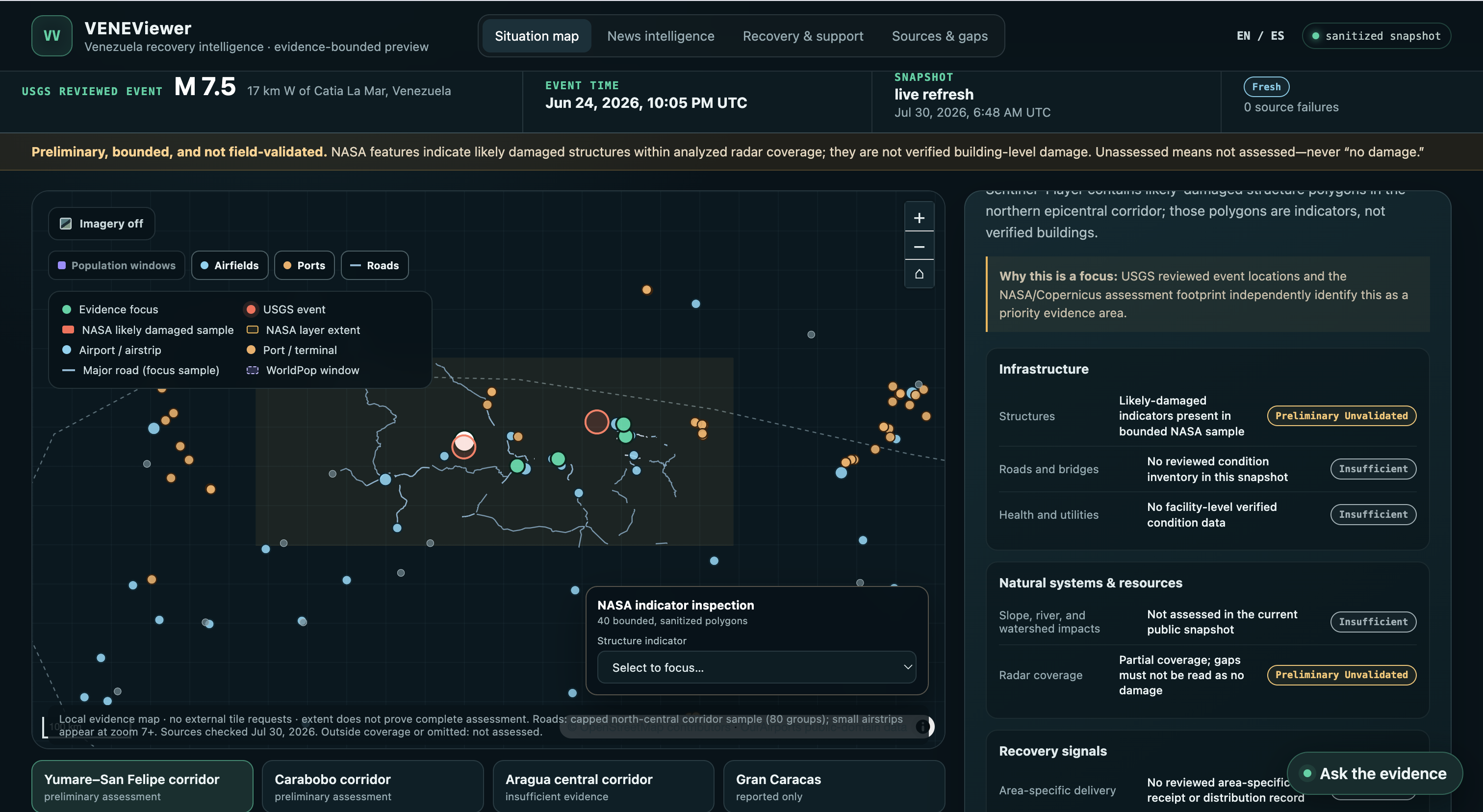
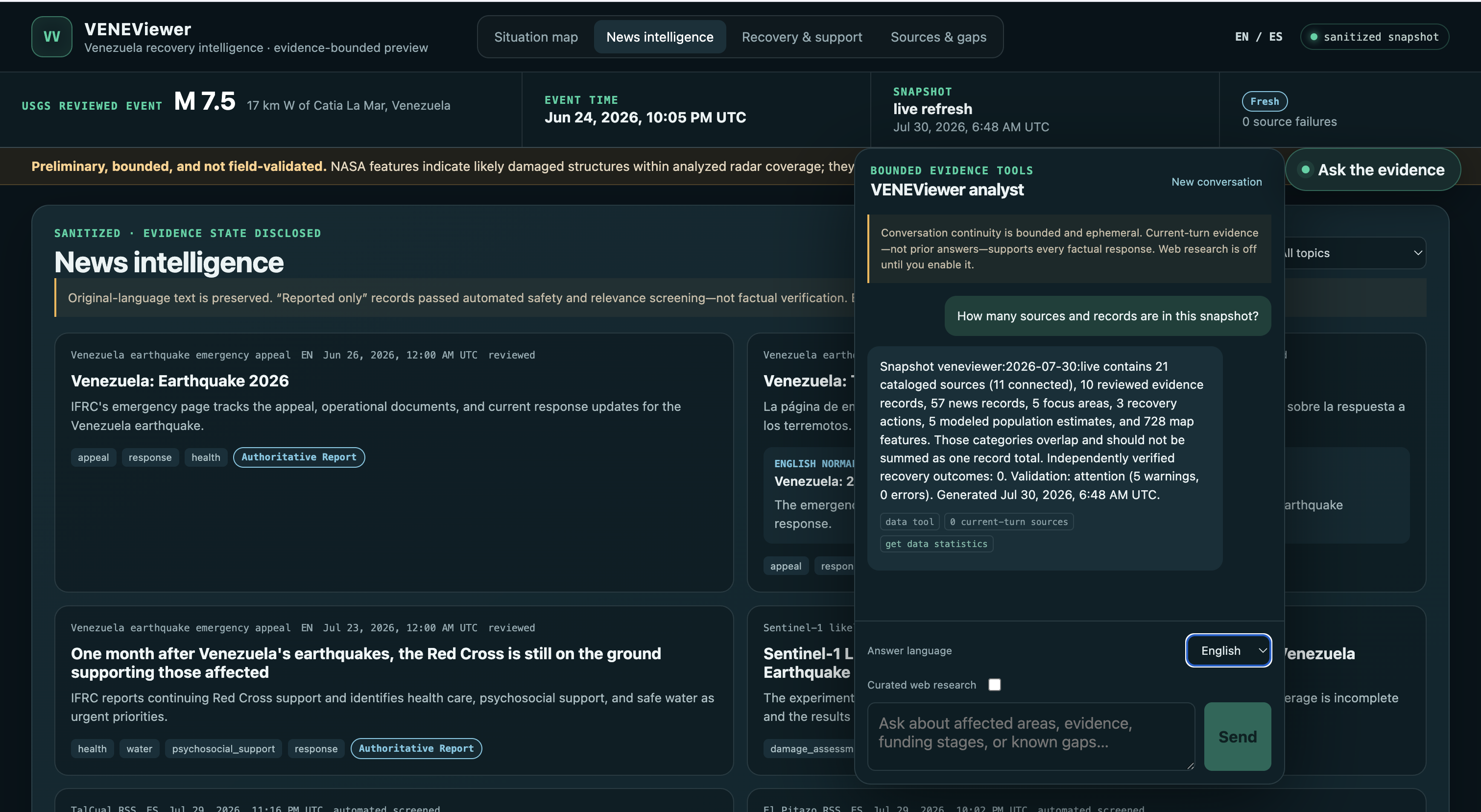
VENEViewer: Situational Awareness for Venezuela Earthquake Response

VENEViewer is an evidence-oriented dashboard that consolidates geospatial, hazard, infrastructure, and recovery-related information into a single map-centered interface. It supports situational awareness for Venezuela earthquake response and recovery, letting users review conditions alongside the sources backing them.

  • Map-centered interface for spatial review of hazard, infrastructure, and recovery layers
  • Selected authoritative data brought together with visible source attribution for each layer
  • Early public prototype for stakeholder exploration and validation - not an official emergency-management system
Response Radar overview dashboard
Situation map — evidence-focused dashboard view with map, layer toggles, and structured infrastructure status indicators
Response Radar comment and video detail view
News intelligence — curated, translated, and categorized event reporting with semantic search and conversational querying

Contact

Interested in the work, collaboration, or access to these tools? Reach out to us: