| Home | Syllabus | Title Page | Introduction | Lo Tech and Hi Tech Tools | AAC Tools | iPad and Tablet Technology | Conclusion | Bibliography |
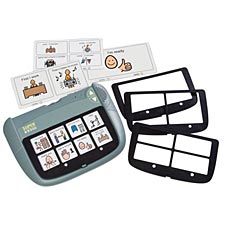
This lower high-tech static display device pictured is the Ablenet Super Talker Progressive Communicator (Ablenet SuperTalker Progressive Communicator, 2010). For each picture, the teacher or caregiver records the name of the picture, so when the child selects it they can hear the name. Say they choose a picture of a cat. The recording could say cat, or say meow if the lesson for that display is sounds animals say rather than what is the name of the animal. The pictures are manually changed. Another option with the static display is how many pictures are available. The topic board or overlay can be changed to give more or less options. The static display offers the user the option of combining words to create a message (ASHA, 1997).

This electronic device, displaying pictures for vocabulary that are electronically changed, is a dynamic display. Pictured is DynaVox V+™ (DynaVox V+, 2011). Others have more frames or less, but each frame represents a picture and a sound when activated. The dynamic display system offers the user access to many layers of vocabulary and the option to create new messages quickly (DynaVox V+, 2011).
The introduction of tablet computers has changed the face of teaching communication strategies to children with disabilities. The previously mentioned tools have many applications but they are finite. With the ability to access the many voice output applications available, the possibilities are endless. These tablets make conversation portable, especially for older students. The iPad and tablet computers appeal to children because they blend in more with their friends, which can increase motivation to use the device as a means to communicate. Research has also shown that the touch screen capabilities simplify access to the devices for children (Light & Drager, 2007).