|
*The
College of Education and Human Development magazine at George Mason
describes my work*
Polyvocal
Professional Learning through Self-Study Research (2015)
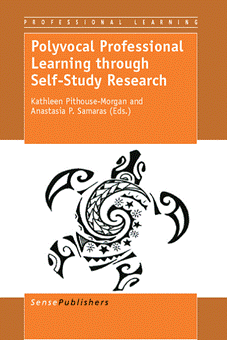 Polyvocal Professional Learning through
Self-Study Research illustrates the power of “we” for innovative and
authentic professional learning. The 33 contributors to this book
include experienced and emerging self-study researchers, writing in
collaboration, across multiple professions, academic disciplines,
contexts, and continents. These authors have noted and reviewed each
other’s chapters and adapted their contributions to generate a
polyvocal conversation that significantly advances scholarship on
professional learning through self-study research. Building on, and
extending, the existing body of work on self-study research, the book
offers an extensive and in-depth scholarly exploration of the how, why,
and impact of professional learning through context-specific,
practitioner-led inquiry. The chapters illustrate polyvocal
professional learning as both phenomenon and method, with the original
research that is presented in every chapter adding to the forms of
methodological inventiveness that have been developed and documented
within the self-study research community. Polyvocal Professional Learning through
Self-Study Research illustrates the power of “we” for innovative and
authentic professional learning. The 33 contributors to this book
include experienced and emerging self-study researchers, writing in
collaboration, across multiple professions, academic disciplines,
contexts, and continents. These authors have noted and reviewed each
other’s chapters and adapted their contributions to generate a
polyvocal conversation that significantly advances scholarship on
professional learning through self-study research. Building on, and
extending, the existing body of work on self-study research, the book
offers an extensive and in-depth scholarly exploration of the how, why,
and impact of professional learning through context-specific,
practitioner-led inquiry. The chapters illustrate polyvocal
professional learning as both phenomenon and method, with the original
research that is presented in every chapter adding to the forms of
methodological inventiveness that have been developed and documented
within the self-study research community.
For a free preview containing the first two chapters of
the book, please visit the book’s product page.
Self-Study
Teacher Research: Improving Practice Through Collaborative Inquiry
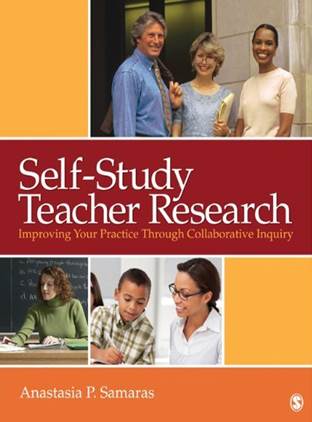 Sage Publications
writes: The first textbook to offer novice and experienced teachers
guidelines for the “how” and “why” of self-study teacher research.
Designed to help pre- and in-service teachers plan, implement, and
assess a manageable self-study research project, this unique textbook
covers the foundation, history, theoretical underpinnings, and methods
of self-study research. Author Anastasia Samaras encourages readers to
think deeply about both the “how” and the “why” of this essential
professional development tool as they pose questions and formulate
personal theories to improve professional practice. Written in a
reader-friendly style and filled with interactive activities and
examples, the book helps teachers every step of the way as they learn
and refine research skills; conduct a literature review; design a
research study; work in validation groups; collect and analyze data;
interpret findings; develop skills in peer critique and review; and
write, present, and publish their studies. Sage Publications
writes: The first textbook to offer novice and experienced teachers
guidelines for the “how” and “why” of self-study teacher research.
Designed to help pre- and in-service teachers plan, implement, and
assess a manageable self-study research project, this unique textbook
covers the foundation, history, theoretical underpinnings, and methods
of self-study research. Author Anastasia Samaras encourages readers to
think deeply about both the “how” and the “why” of this essential
professional development tool as they pose questions and formulate
personal theories to improve professional practice. Written in a
reader-friendly style and filled with interactive activities and
examples, the book helps teachers every step of the way as they learn
and refine research skills; conduct a literature review; design a
research study; work in validation groups; collect and analyze data;
interpret findings; develop skills in peer critique and review; and
write, present, and publish their studies.
For the publisher's order form, click here.
Learning
Communities In Practice
 Most would agree that a learning community of
practice cultivates social and intellectual development in educational
settings but what are the other benefits and what does a learning
community actually look like in practice? This book explores such
questions as: "Are learning communities essential in
education?" "How are they designed and developed?"
"What difference do they make in learning?" The book contains
contributions of educators who share their research and practice in designing
and implementing learning communities in school, university, and
professional network settings. It presents their experiences, and the
"how to" of these educators who are passionate about building
and sustaining learning communities to make a real difference for students,
teachers, faculty, and communities. Combining scholarly and
practitioner research, the book offers practical information to
teachers, school and university administrators, teacher educators, and
community educators. Most would agree that a learning community of
practice cultivates social and intellectual development in educational
settings but what are the other benefits and what does a learning
community actually look like in practice? This book explores such
questions as: "Are learning communities essential in
education?" "How are they designed and developed?"
"What difference do they make in learning?" The book contains
contributions of educators who share their research and practice in designing
and implementing learning communities in school, university, and
professional network settings. It presents their experiences, and the
"how to" of these educators who are passionate about building
and sustaining learning communities to make a real difference for students,
teachers, faculty, and communities. Combining scholarly and
practitioner research, the book offers practical information to
teachers, school and university administrators, teacher educators, and
community educators.
For the publisher's order form, click here.
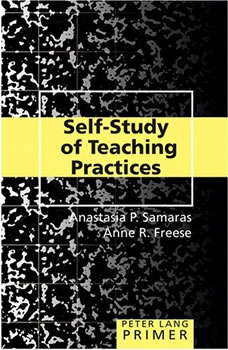 Self-study of Teaching Practices
Primer Self-study of Teaching Practices
Primer
The Self-Study of Teaching Practices
Primer introduces you to the field of self-study research and practice.
This student and teacher friendly version provides a comprehensive
review and synthesis of the self-study literature; complete with
guidelines and examples of cutting-edge self-study methods. The primer
addresses four central areas of self-study of teaching practices:
purposes, foundations, nature, and guidelines for practice.
School-based and university-based teachers interested in rethinking and
reframing their teaching will benefit from reading this book. The
primer is an excellent resource for undergraduate and graduate
education students who are searching for guidelines to develop and
improve their teaching practice. Includes glossaries and references.
For the publisher's order form, click here.
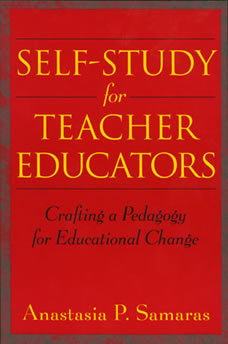
Self-Study for
Teacher Educators: Crafting a Pedagogy for Educational Change
 I am
called a self-study teacher educator, a scholarship Ken Zechner viewed as “the single most significant
research area in teacher education” (AERA, 1998). I employ a
post-modern self-study methodology as a way to reinvent teacher
education through my action research along with a continuous
interrogation and reflection of my teaching practice and underlying
assumptions that influence my teaching. An analysis of one's teaching
has important implications for teacher education programs, especially
as it becomes increasing shared, scrutinized, and enriched through
conversation and critiqued by a self-study community of scholars. I am
called a self-study teacher educator, a scholarship Ken Zechner viewed as “the single most significant
research area in teacher education” (AERA, 1998). I employ a
post-modern self-study methodology as a way to reinvent teacher
education through my action research along with a continuous
interrogation and reflection of my teaching practice and underlying
assumptions that influence my teaching. An analysis of one's teaching
has important implications for teacher education programs, especially
as it becomes increasing shared, scrutinized, and enriched through
conversation and critiqued by a self-study community of scholars.
I use the words self-study as a component
of reflection where faculty are asked to critically examine their
actions and the context of those actions for the purpose of a more
consciously-driven mode of professional activity, as contrasted with
action based on habit, tradition, or impulse. By researching their own
practice, self-study teacher educators question problems of teacher
education and how their actions contribute to those problems. This in
turn, contributes to the knowledge base of teaching, the development of
the person, the professional, and the teacher education program. The
area of self-study entails making public my critical and active
reflection about my teaching and insights gained through action
research.
My research is centered on the study of my
teaching practices in an effort to improve my teaching, teachers’
professional development, and consequently children’s
learning. I developed and have been investigating a model for teacher
education based in sociopolitical theory, which stems from my doctorate
research (Samaras, 2002). The model includes: knowing students and the
social and cultural forces that shape development, situating learning,
structuring and mediating learning experiences, designing collaborative
activities, and providing students opportunities to instructionally
converse and develop common systems of understanding about teaching
with peers. Much like in natural settings for learning in families,
communities, and the workplace, teaching is based on the premise that
learning takes place through joint and productive activity in authentic
contexts (i.e., in schools) towards mutual tasks (e.g., action learning
and research). According to the American Association of Colleges for
Teacher Education, teachers need to be placed in collaborative learning
environments and teacher educators need to recognize teaching as a
public, not individual, act. This collaborative enterprise for
teachers’ and faculty professional development alike,
is central to my research and self-study of those teaching practices.
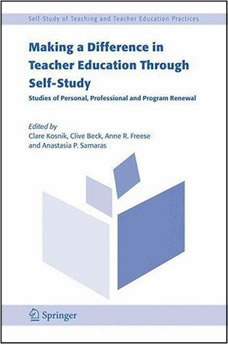
Making a
Difference in Teacher Education Through Self-Study : Studies of
Personal, Professional and Program Renewal
 The challenges teacher educators are now facing are
of a different nature from those of the past few decades. They have
taken on an urgency and a magnitude not
witnessed before. Strict government control of education is increasing,
the social problems in the schools are more severe, the budget
restrictions we face in the university are greater, and the public
disillusionment with education, in general, is more than just a passing
malaise. This period will be crucial to the future of teacher
education; we need to rally together to examine our practice, renew our
programs accordingly, collaborate with others, and offer examples of
programs that do make a difference. Making a difference in Teacher
Education through Self-Study: Studies of Personal, Professional, and
Program Renewal describes the systematic
efforts of committed and creative teacher educators to improve their
teacher education programs. It describes the accomplishments of
individuals (and in part the programs in which they work) who have
overcome many of the hurdles teacher educators typically face. These
individuals have made a difference in the lives of their students,
their colleagues, and many classroom teachers. The book presents
research on 15 different teacher education programs and describes
individual renewal efforts. The stories -- including both the successes
and challenges -- are inspiring and informative. In this age of
accountability these teacher educators have used a range of research
methods to gather data on their work and in turn used it to guide
future decisions. The text includes examples of both large scale
research and individual efforts. The common thread among the authors is
a commitment to "walking the talk." The challenges teacher educators are now facing are
of a different nature from those of the past few decades. They have
taken on an urgency and a magnitude not
witnessed before. Strict government control of education is increasing,
the social problems in the schools are more severe, the budget
restrictions we face in the university are greater, and the public
disillusionment with education, in general, is more than just a passing
malaise. This period will be crucial to the future of teacher
education; we need to rally together to examine our practice, renew our
programs accordingly, collaborate with others, and offer examples of
programs that do make a difference. Making a difference in Teacher
Education through Self-Study: Studies of Personal, Professional, and
Program Renewal describes the systematic
efforts of committed and creative teacher educators to improve their
teacher education programs. It describes the accomplishments of
individuals (and in part the programs in which they work) who have
overcome many of the hurdles teacher educators typically face. These
individuals have made a difference in the lives of their students,
their colleagues, and many classroom teachers. The book presents
research on 15 different teacher education programs and describes
individual renewal efforts. The stories -- including both the successes
and challenges -- are inspiring and informative. In this age of
accountability these teacher educators have used a range of research
methods to gather data on their work and in turn used it to guide
future decisions. The text includes examples of both large scale
research and individual efforts. The common thread among the authors is
a commitment to "walking the talk."

|