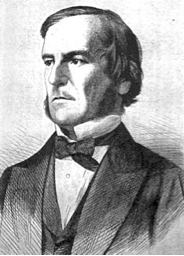
Born on November 2, 1815, George Boole was a mathematician who left an indelible footprint on computer science. From a young age, Boole's father, a tradesman, would teach Boole mathematics. At the age of 16, Boole became a teacher at a private school, and a few years later, he opened his own school to pursue higher-level math. At 24 years old, he was published in the esteemed Cambridge Mathematical Journal, a remarkable feat considering he had not had much formal training. In 1849, Boole became Chair and First Professor of Mathematics at Queens College Ireland and spent the rest of his life here. Boole published several books on mathematics, including The Mathematical Analysis of Logic and An Investigation of the Laws of Thought on Which are Founded the Mathematical Theories of Logic and Probabilities. (Dale et al. 95).
Boole is most famous for his contribution to Boolean algebra, which lays the rudiments for virtually every digital computer. Unlike ordinary algebra, which has an infinite set of numbers, Boolean algebra relies strictly on two values: 0 and 1. Boole associated the value 0 with an empty set and 1 with the universal set. In boolean algebra, the digit 0 represents False, and 1 represents True (University of Babylon). This algebraic notation proved itnstrumental in computer science, paving the way for circuit development and computer programming. Using mathematical reasoning from Boolean algebra, we can manipulate circuit logic using specific operations like AND, OR, and NOT, as well as commutative or associative property (Dale et al. 94). Tangentially, in the programming world, boolean operators can be used in conjunction with boolean expressions to create complex decision-making processes, allowing programmers to form conditional loops and statements (AG, n.d.) With its impact on computer development and programming, Boole's logic system incontrovertibly revolutionized how we picture computer science.
Unfortunately, Boole died at the peak of his career at the age of 49 due to pneumonia. Though he received little recognition for his work during his time, Boole's legacy continues to shape our understanding of computer science, and it is safe to say that his contributions unequivocally laid the rudiments for the development of technology.