
Ball's Bluff/Leesburg
On Oct. 21, 1861, Union forces stumbled on to Confederate camp at the Potomac near Loudoun County in Virginia,  and Montgomery County in Maryland. Casualties were heavy for the Union, and included Col. Edward Baker. The Confederate forces were led by Brig. Gen. Nathan "Shanks" Evans. The Federal forces were attempting to cross the River at Harrison's Island in order to take Leesburg. The Confederate victory led to the creation of the Congressional Joint Committee on the Conduct of the War.1
Today, Loudoun County is one of the fastest growing counties in the nation. While still more rural than most of the D.C. area, land is increasingly expensive and being sold in smaller and smaller lots. As the developers use the converted farm land for condos and houses, modern civilization begins to creep nearer to our Civil War Landmarks. The land Ball's Bluff battlefield occupies is protected by federal law, but with the increase of modernization, the feeling of the past is not as powerful.
Ox Hill/Chantilly
 Fought on September 1, 1862, it was part of the Second Bull Run campaign. General Thomas “Stonewall” Jackson and his men were marching from Manassas and Centreville to meet up with troops already in Chantilly in an attempt to prevent a Union retreat from Bull Run. Positioned near the Little River Turnpike and Ox Hill, Jackson's men met the Union forces of Kearny and Stevens. After losing a significant number of troops, Maj. Gen. John Pope sounded retreat and the men headed for Washington. Shortly after this engagement, Maj. Gen. George B. McClellan became the commander of the forces near Washington, and General Robert E. Lee began his campaigns of South Mountain and Antietam. 2
We have had a terrific battle again to-day. The enemy, largely reinforced, assaulted our position early to-day. We held our ground firmly until six o'clock P.M., when the enemy, massing very heavy forces on our left, forced back that wing about half a mile. At dark we held that position. Under all the circumstances, both horses and men having been two days without food, and the enemy greatly outnumbering us, I thought it best to move back to this place at dark. The movement has been made in perfect order and without loss The troops are in good heart and marched off the field without the least hurry or confusion. Their conduct was very fine.
- Gen. Pope in a dispatch to Gen. Halleck, September 18623
Today, Chantilly, and the area of Ox Hill are thriving residential and commercial centers. Shopping centers, business offices, and apartments are only blocks from the Ox Hill battlefield park. There are two State Historical signs, and a tableau showing troop movements, but the total land area is not very large. The trees are not dense, and apartments can be seen through them. There is a small walkway so visitors can enter the park, but it is not long. Chantilly is a booming area, with a lot of industry and housing, with several major highways crisscrossing it. After comparing historical maps to contemporary maps, it is easy to see that many of the modern roads follow similar paths to the roads walked daily by Confederate and Union Troops.
[The 15th Mass.] will answer any summons from you to another contest with the foe, although with diminished numbers, with as hearty a zest as on the morning of October 21.
- Col. Deven's offical report of the Battle of Ball's Bluff.4
Bull Run/Manassas
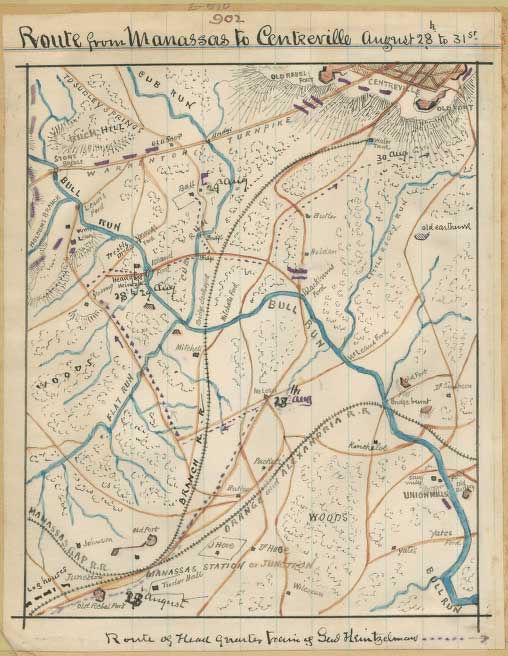 In addition to Fort Sumter, and Gettysburg, the battle of Bull Run is among the list of major Civil War battles. Nearby Centreville served as a staging area, campsite, and hospital for both sides as the area changed hands. The first battle of Bull Run was fought on July 21, 1861, and created heavy causalities on all sides. As the first major battle scene in Virginia, Brig. Gen. Irvin McDowell and his men were tested close enough to Washington for easy retreat, but far enough into Confederate territory to be at a strategic disadvantage. Fighting began in the morning of July 21 st with McDowell attacked the Confederate flank nearly Sudley Ford. As the day drew to a close, Confederate reinforcements arrived from the southern and western Virginia, and forced the Federals into a retreat. Confederate causalities were more that seventeen hundred, and the Union troops suffered almost three thousand dead. After returning to Washington, Brig. Gen. McDowell was removed from his post, and replaced with Maj. Gen. George McClellan.5
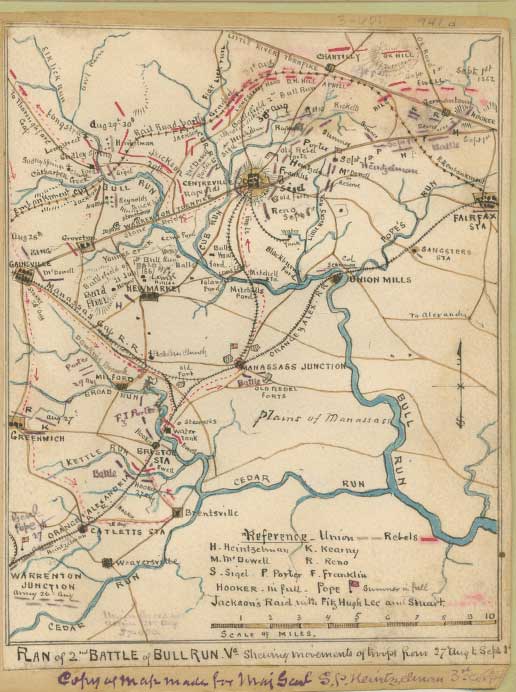 The Bull Run/Manassas battle field is different from the others presented here, because it has a large, protected area of land. The major roads that cut through the fields are two-lane, and are paved versions of the old foot paths. The park is also well known and well organized.
Conclution
(Conclution)