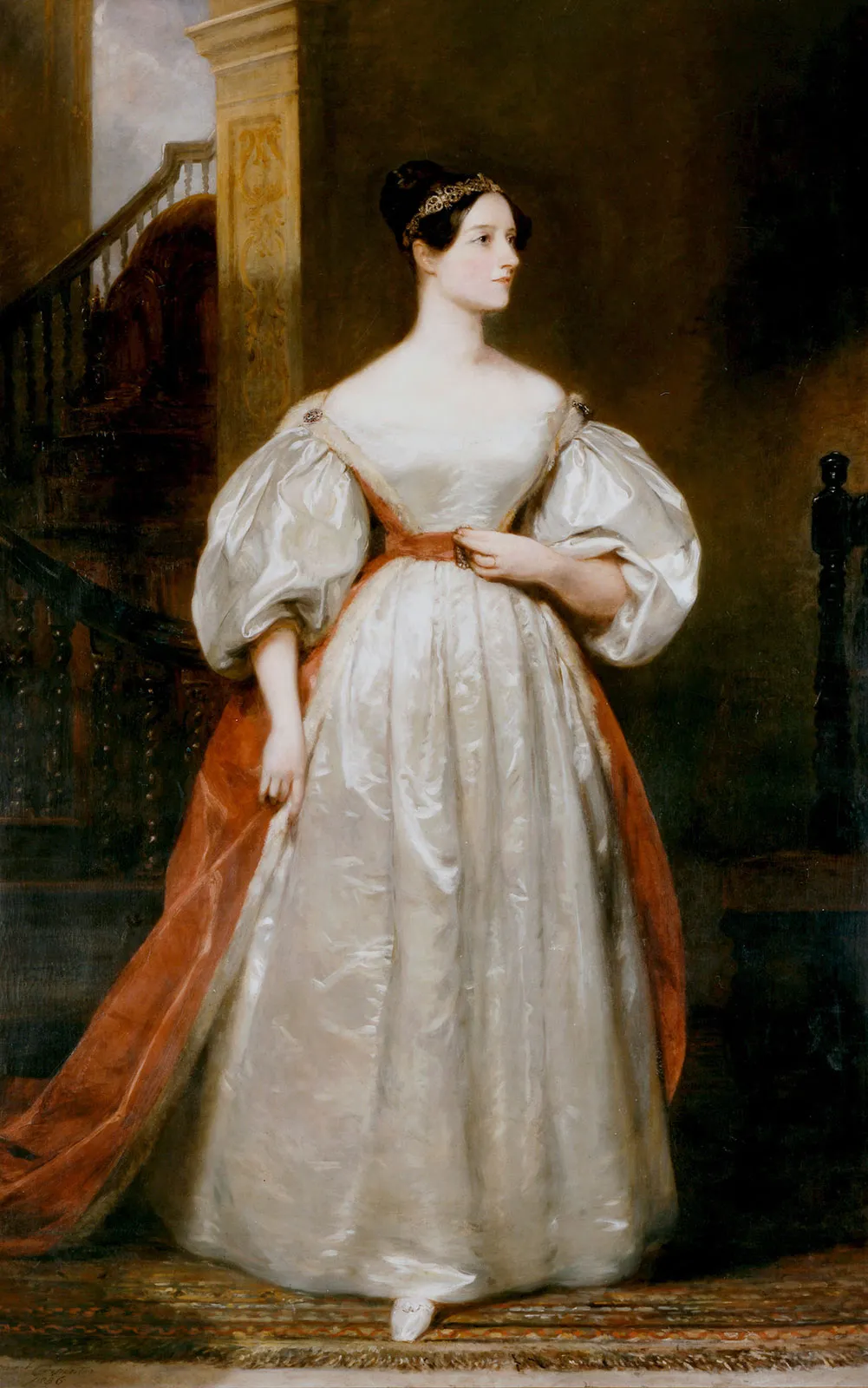
Fig. 1. Carpenter, Margaret. Ada
Lovelace. Encyclopaedia Britannica,
https://www.britannica.com/biography
/Ada-Lovelace/images-videos#/media/
1/349551/218453.
Fig. 1. Carpenter, Margaret. Ada
Lovelace. Encyclopaedia Britannica,
https://www.britannica.com/biography
/Ada-Lovelace/images-videos#/media/
1/349551/218453.
Ada Lovelace was a highly influential person in the field of computer science. Many of her ideas and innovations laid the groundwork for modern computer science.
From a young age, Lovelace was instructed heavily in mathematics and poetry, including teachings from well-respected figures like Augustus DeMorgan and Dr. Dionysius Lardner (Dale and Lewis). In her studies, she became interested in Charles Babbage’s Difference Engine, a theoretical "mechanical calculating machine" not yet built at the time, and worked with him extensively (Dale and Lewis 14). Most notably, Lovelace developed programs for the Difference Engine and expressed the potential for Babbage's subsequent invention, the Analytical Engine, to go beyond his initial aspirations. While Babbage's Analytical Engine was initially theorized as an all-purpose improvement of the Difference Engine able to compute a wider range of calculations, Lovelace proposed it could be purposed into a “general manipulator of symbols…having far-reaching capabilities”, including the ability to compute Bernoulli numbers and even produce music (Dale and Lewis 14; Swaine and Freiberger; The Editors of Encyclopaedia Britannica).
Eventually, Lovelace took on the challenge of translating the article Notions sur la machine analytique de Charles Babbage by Italian mathematician Luigi Menabrea into The Sketch of the Analytical Engine, adding in thorough annotations that nearly warranted their own article due to having been longer than the initial document (Dale and Lewis; The Editors of Encyclopaedia Britannica). In the process, she popularized her ideas of programming devices to go beyond doing solely arithmetic, and in doing so greatly progressed the world of computing closer to the modern day.
Lovelace's work with Babbage on the Difference Engine eventually led to a working prototype being made shortly after her death (Dale and Lewis). Further, between the programs she wrote for the Difference Engine and her theories about programming the Analytic Engine to do tasks beyond basic computations, her ideas came to be the foundation of modern computing. As such, it is fitting that many consider her to be the world’s first programmer.
Visit the CS Department Website for more information on the Computer Science major at George Mason.
Carpenter, Margaret. Ada Lovelace. Encyclopaedia Britannica, https://www.britannica.com/biography/Ada-Lovelace/images-videos#/media/1/349551/218453.
Dale, Nell, and John Lewis. Computer Science Illuminated. 6th ed., Jones and Bartlett Learning, 2016.
Swaine, Michael R. and Freiberger, Paul A. "Analytical Engine". Encyclopedia Britannica, 15 Jun. 2023, https://www.britannica.com/technology/Analytical-Engine. Accessed 28 September 2023.
The Editors of Encyclopaedia Britannica. "Ada Lovelace". Encyclopedia Britannica, 14 Aug. 2023, https://www.britannica.com/biography/Ada-Lovelace. Accessed 27 September 2023.