Barry A. Klinger, win 12 Tue, 2020.
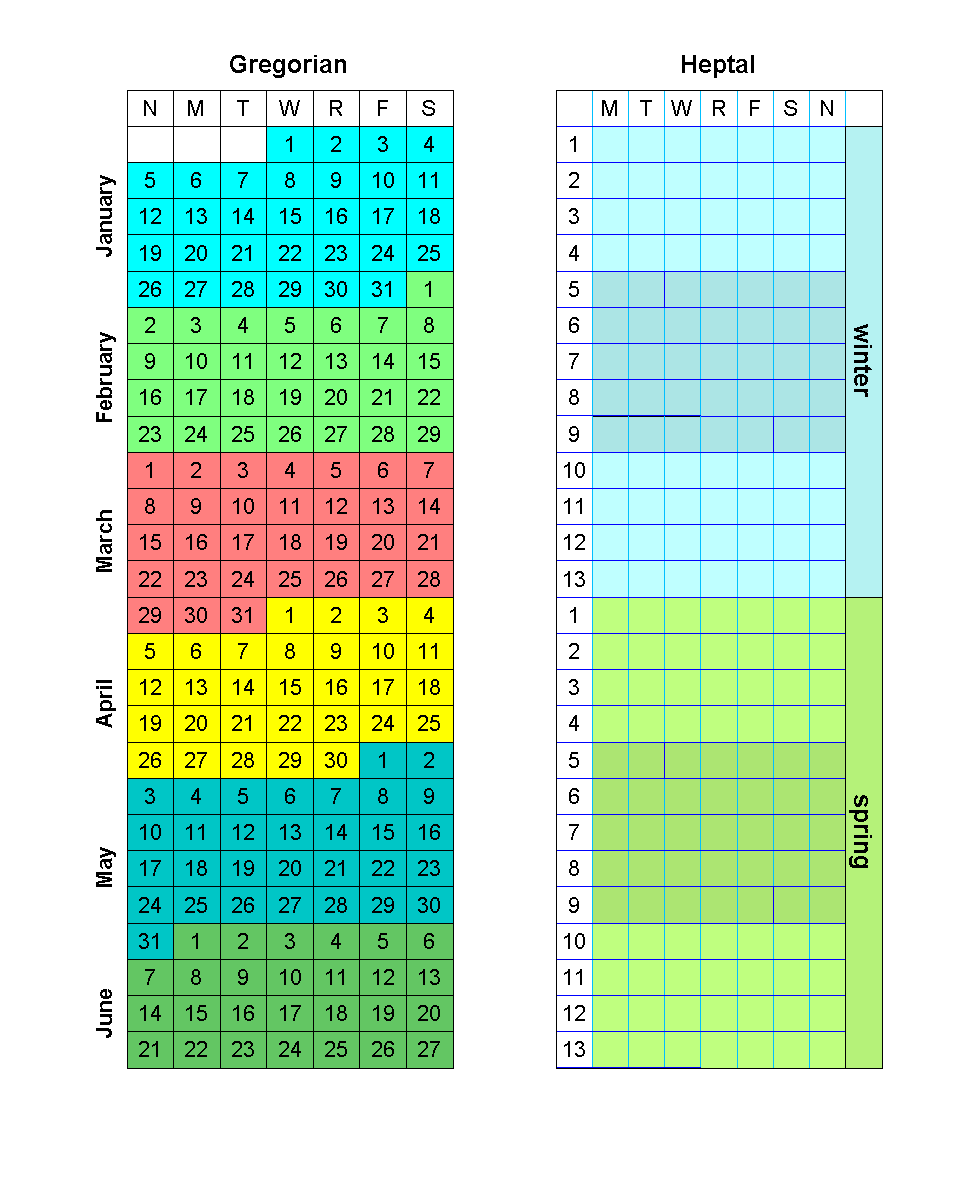
A side-by-side comparison shows the simplicity of the Heptal Calendar compared to the chaos of the Gregorian.
The grid on the left shows the Gregorian calendar for the first half of 2020. Locating an event on a specific day amounts to finding that day in the grid. The pentomino-like shape of the months immediately displays the randomness of the calendar. Months can begin on any day of the week, with no discernable pattern. To find your way through the dates, you count up the numbers of all the days till you reach 30, 31, 28, or 29 (depending on the month and year) and then go back to 1 and start all over. Nobody would navigate on a map like that, but this is what we must traverse when we use the Gregorian Calendar to find our way in time.
As the grid on the right shows, the Heptal Calendar takes advantage of the idea of coordinates to easily locate any day. Week and day are equivalent to longitude and latitude, like putting a peg at B5 in the game Battleship. In the Heptal Calendar, you go across to the day of the week you want, go down to the week you want, and you are done. If someone tells you that there is an event on Wed of winter week 5, you know exactly where that is on the grid without even having to look.
It is true that we can all use the calendar to find days, but why should we have to? Why should we need to pull out our phone or open a new window on our computer because someone said our flight is the seventeenth and we can't remember if that is a Tuesday or a Wednesday?
Good organization promotes good thinking. If the calendar is trivial to navigate, it is much easier to picture your schedule and to concentrate on other things than scrolling through the dates.
The seasons naturally divide into groups of 4 weeks at the beginning and end of the season and five weeks in the middle. The twelve such divisions in a year are somewhat like months. Of course, the middle one of each three such divisions is 25% longer than the other two.
For some purposes, such as paying rent or collecting a paycheck, it may be useful to have more even months. The Heptal Calendar accomodates this as well. If the first and third division of each season take two days from the middle division, the resulting "months" will have lengths of 30, 31, and 30 days, respectively. The "stolen" days are always Mon & Tue of week 5 and Sat & Sun of week 9. For functions that need months, it's not hard to carve them out of the Heptal Calendar. For everything else, we can ignore these extra divisions and just use weeks and days.
Last modified: win 12 Tue 2020